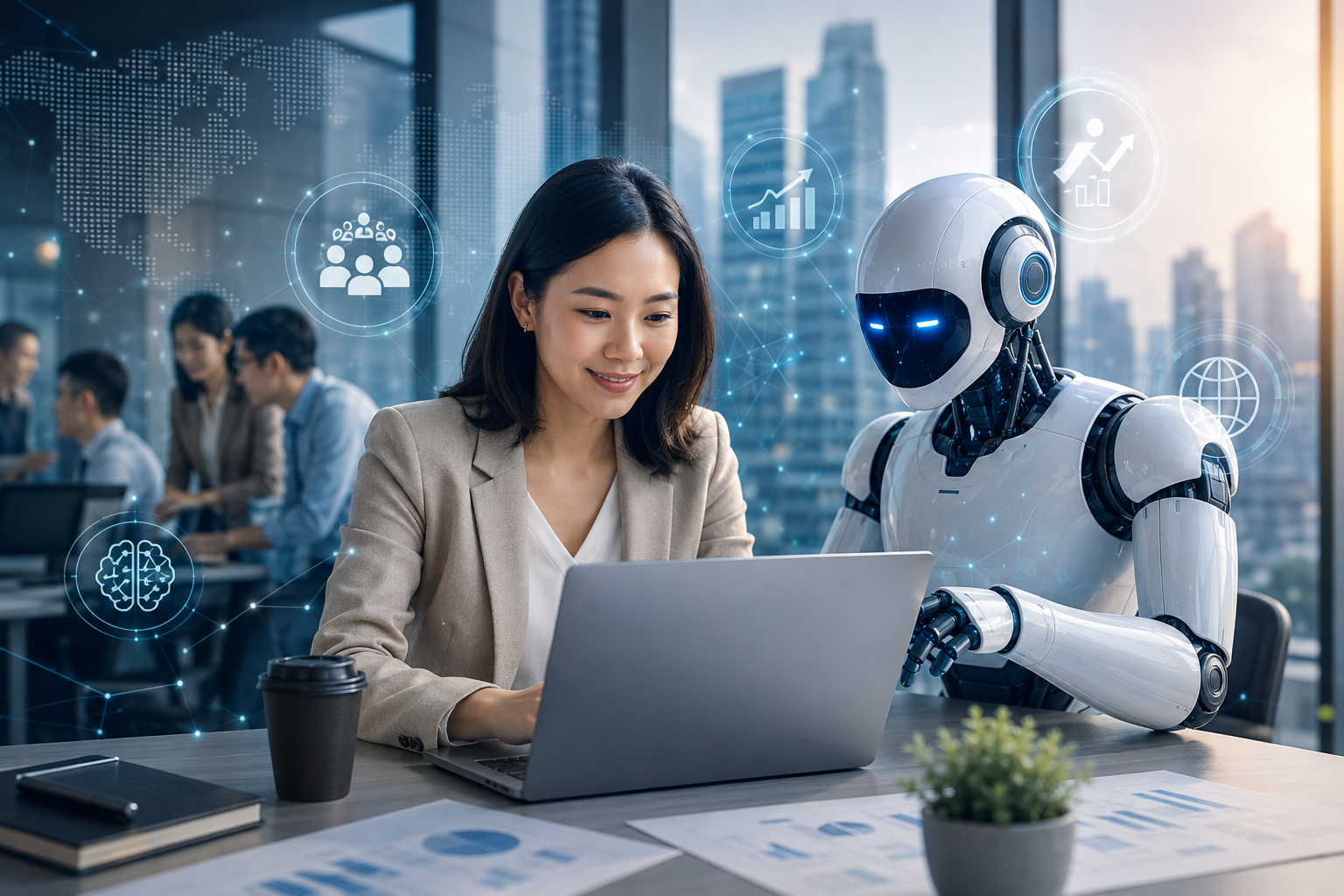
The conversation around workforce transformation has shifted dramatically in recent years. What was once focused on digitisation and automation is now entering a more complex phase—one driven by AI agents.
AI agents are not just tools. They are autonomous or semi-autonomous systems capable of executing tasks, making decisions, and collaborating with humans. As organisations across industries adopt these technologies, workforce transformation is no longer optional—it is foundational.
Yet the narrative is often misunderstood. AI agents are not simply about replacing tasks; they are reshaping how work is designed, how skills are valued, and how organisations evolve. The real opportunity lies in how businesses integrate AI with human capability to unlock new forms of productivity and growth.
AI agents go beyond traditional automation. Unlike rule-based systems, they can learn, adapt, and operate across workflows with minimal human intervention.
Examples include:
According to the World Economic Forum, advancements in AI are accelerating the shift toward “augmentation” rather than simple automation. This means AI agents are increasingly embedded into daily work, acting as collaborators rather than replacements.
Workforce transformation refers to how organisations evolve their people, skills, and structures to remain competitive. AI agents are now a central driver of this shift.
As AI agents take on routine and analytical tasks, job roles are becoming more fluid. Employees are expected to:
This aligns with findings from the OECD, which highlight that task transformation—not job elimination—is the dominant trend.
Global research suggests that a significant portion of skills will change by 2030. AI agents are a key catalyst.
In-demand capabilities now include:
This shift is why organisations are moving toward skills-first strategies rather than relying solely on traditional job frameworks.
AI agents generate and process large volumes of skills data. This allows organisations to:
Skills data becomes the foundation for more agile workforce planning—something that static job descriptions cannot achieve.
Singapore provides a strong example of how AI and workforce transformation intersect at a national level.
Initiatives like Career Health SG—supported by agencies such as Ministry of Manpower and SkillsFuture Singapore—emphasise career resilience and employability.
AI agents can amplify these efforts by:
Despite the potential, integrating AI agents into the workforce comes with challenges.
Many organisations lack the internal capabilities to fully leverage AI. Without targeted upskilling, the gap between technology and talent widens.
Adopting AI agents requires cultural transformation. Employees need clarity on:
Poor or incomplete skills data can limit the effectiveness of AI systems. Organisations must invest in:
To successfully navigate workforce transformation, organisations need a structured approach.
Move beyond job titles and focus on skills as the core unit of workforce planning.
This enables:
AI agents should complement human work, not operate in isolation.
Best practices include:
Learning must become part of everyday work. Organisations should:
AI-driven insights can help match employees to new roles or projects based on their skills.
This supports:
The rise of AI agents marks a turning point in workforce transformation. But the future is not about technology alone—it is about how humans and AI work together.
Organisations that succeed will be those that:
As the World Economic Forum has consistently emphasised, the future of work will depend on balancing technological advancement with human development.
AI agents are reshaping the workforce in profound ways. They are redefining roles, accelerating skills transformation, and enabling more intelligent workforce strategies.
However, the true value lies not in the technology itself, but in how it is applied. By focusing on skills, embracing continuous learning, and fostering human-AI collaboration, organisations can build a workforce that is not only future-ready—but future-resilient.
Workforce transformation is no longer a distant goal. With AI agents, it is already underway.