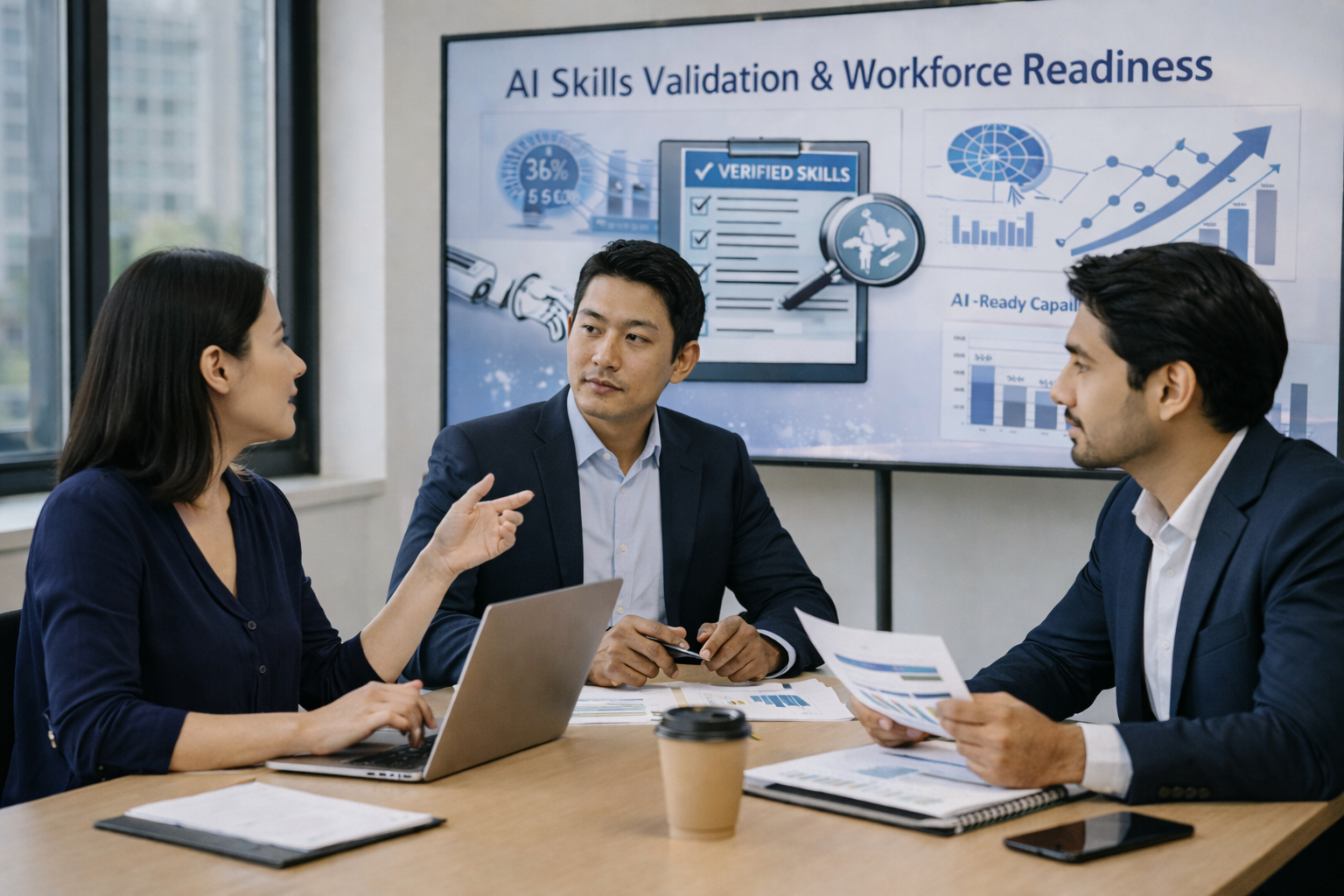
Workforce readiness—not hiring volume—is the true competitive edge. Discover how AI-era skills validation and skills-based career pathways reduce attrition, increase internal mobility, and strengthen enterprise agility.
In just these 2 months of the new year, the conversation in the boardroom has changed.
The question is no longer:
“How do we reduce turnover?”
It is now:
“Is our workforce ready to execute our strategy?”
Attrition is a symptom. Whereby workforce unreadiness is the risk.
As AI adoption accelerates, automation reshapes workflows, and transformation cycles compress from years to quarters, CXOs face a structural challenge: they simply cannot afford to execute business strategy without validated visibility into workforce capability.
This is why leading organizations are moving from reactive retention programs to AI-ready, skills-based career ecosystems.
The shift from attrition to advancement is no longer just purely an HR initiative.
It is a board-level imperative. It must be a top down initiative.
Generative AI, predictive analytics, and automation have not eliminated jobs—they have redefined them, complement them, in short it is an enabler.
Roles are now:
But most workforce systems still operate on outdated structures:
In the AI era, assumptions are expensive and unnecessary.
What you cannot see will fail you. And without validated skills data, workforce planning remains guesswork.
Workforce readiness is the measurable alignment between:
Organizations that lead in 2026 can answer, in real time:
This level of clarity requires more than HR analytics dashboards. It requires a credible skills infrastructure which brings us back to the keyword above “measurable”
High performers leave when:
Employees simply expect transparency.
They want:
Organizations that fail to provide this lose not just talent—but trust as well.
AI has amplified one core risk:
Inflated, unverified skill claims.
Simply put, how much do you trust - Resumes, LinkedIn profiles, and self-assessments data for your strategic planning.
As CXOs we need:
This is where a structured skills assessment platform becomes foundational to workforce governance.
Traditional career ladders assume linear progression, almost too obvious.
For Example: Analyst → Senior Analyst → Manager → Director
Technology adoption may follow a roadmap, but capability evolution does not. As AI reshapes workflows, organizations no longer require siloed expertise progressing up fixed ladders. They require cross-functional agility—the ability to redeploy capability across domains as strategy shifts.
This demands adjacent skill mobility.
The real executive question to be asked are:
Organizations that rely on static role definitions miss this opportunity.
AI transformation succeeds not when new talent is acquired—but when existing talent is activated.
1. Establish a Trusted Skills Baseline
2. Redefine Progression by Capability Thresholds
3. Align Learning Investments to Verified Gaps
4. Activate Internal Mobility with Data-Driven Precision
To put it simply replacing talent costs:
But more importantly, external hiring does not solve internal capability gaps if the organization lacks skills visibility.
Organizations highlighted in structured transformation initiatives increasingly emphasize workforce readiness as the missing link between strategy and execution.
The ROI is not just retention.
It is execution certainty.
Without AI-ready skills architecture:
And worse—strategic initiatives fail quietly due to unseen readiness gaps.
Failure is rarely about technology. It is about workforce preparedness.
Looking ahead, we can expect:
But the foundation remains the same:
Trusted skills data.
Organizations that treat skills as infrastructure—not initiative—will outpace competitors.
Those that delay will struggle to align talent with transformation speed.
The shift from attrition to advancement is not about retention programs.
It is about building:
To be perfectly clear, the most valuable asset in your organization is not AI.
It is a workforce ready to execute with it.
The question is no longer whether you invest in skills-based career pathways.
The question is whether you can afford not to.